
Most people assume a thematic board game is just one with a cool story on the box. That assumption misses almost everything that makes these games special. A thematic board game is defined by the deep integration of narrative, visual design, and game mechanics that work together to create a living, breathing experience at the table. The theme does not sit on top of the rules like a coat of paint. It runs through every decision, every component, and every moment of play. This guide breaks down exactly what defines a thematic game, how to recognize one, and how to choose the right one for you.
Table of Contents
Key takeaways
| Point | Details |
|---|---|
| Theme must be integrated | Thematic games weave story into mechanics, not just artwork or flavor text. |
| Mechanics carry the narrative | If you can swap the theme without changing the rules, the theme is superficial. |
| Player imagination matters | You actively create meaning from the mechanics to bring the game world alive. |
| Genre shapes experience | Adventure, horror, and sci-fi themes produce very different player feelings and decisions. |
| Choosing well starts with genre | Pick a theme that resonates with you personally, then evaluate how well mechanics support it. |
What is a thematic board game, really?
The clearest definition comes down to three things working together. According to thematic integration theory, a thematic board game is built on three pillars: thematic illustration, thematic setting, and thematic mechanics. Remove any one of them, and the experience starts to fall apart.
Thematic illustration means the artwork, components, and visual design reinforce the world the game is trying to create. Think sculpted miniatures, illustrated cards, and atmospheric board art that all point to the same fictional universe.
Thematic setting is the where and when of the game world. It gives context to every action. Are you a ghost hunter in 1920s Arkham? A pirate bluffing your way through treacherous waters? The setting makes your decisions feel meaningful rather than arbitrary.
Thematic mechanics are the most critical pillar. This is where most games either succeed or fail at being truly thematic. The rules themselves should reflect the story. A game about deception should have bluffing mechanics. A game about survival should make resources feel scarce and precious.
Here is what separates a thematic game from one with a pasted-on theme:
-
In a thematic game, the mechanics justify the story. Your action makes sense because of who you are in the world.
-
In a pasted-on theme game, the mechanics exist independently. You could replace the pirates with space robots and nothing about the rules would change.
-
Thematic games use components as storytelling tools, not just tokens on a board.
-
The theme, setting, and message in a well-designed thematic game are distinct but inseparable.
Pro Tip: When evaluating a new game, ask yourself: “Does the theme explain why I’m doing what I’m doing?” If the answer is yes, you’re probably looking at a genuinely thematic design.
Common thematic genres and standout examples
Thematic games span a wide range of genres, and the genre you choose shapes your entire experience. Here is a quick look at the most popular categories and what makes each one distinctive.
| Genre | Defining Feel | Notable Examples |
|---|---|---|
| Adventure / Fantasy | Exploration, questing, character growth | Gloomhaven, War of the Ring |
| Horror | Tension, dread, resource pressure | Arkham Horror, Zombicide |
| Science Fiction | Galactic scale, faction conflict | Twilight Imperium, Spirit Island |
| Nature / Wildlife | Calm strategy, ecosystem building | Wingspan |
| Pirate / Deception | Bluffing, risk, social play | Lying Pirates |
Popular thematic titles like Gloomhaven, Arkham Horror: The Card Game, Spirit Island, and War of the Ring are frequently cited as benchmarks of the genre because each one uses its setting to drive every rule and decision. Gloomhaven makes you feel like a mercenary because your character has a personal quest, permanent consequences, and a world that changes based on your choices.
Arkham Horror drowns you in Lovecraftian dread by making your investigator physically deteriorate as the game progresses. The horror is not just in the artwork. It is in the mechanics.
Pro Tip: If you are new to thematic games, start with a genre you already love in other media. If you enjoy horror films, Arkham Horror will click immediately. If you love swashbuckling adventures, a pirate-themed game will pull you in from the first turn.
How mechanics and player imagination create the experience
Here is the part most explanations skip. Mechanics alone do not create a thematic experience. You do.
Thematic depth depends on a player’s ability to connect abstract actions to the game’s narrative. When you roll dice in a thematic game, you are not just generating numbers. You are deciding whether your crew can hold the ship together in a storm. The mechanic clicks because you bring the story to it.
This is what separates theme as art from theme as interactive experience. A painting can show you a pirate ship. A thematic board game makes you captain one. The difference is player agency and imagination working alongside the mechanics.
Consider how Wingspan handles this. The game involves managing bird habitats and scoring points across several rounds. On paper, that sounds like a dry engine-builder. But the detailed bird cards, each with real species information and gorgeous illustrations, make every card you play feel like a small discovery. You are not just placing a token. You are welcoming a species into your wildlife preserve.
“Theme is not just narrative or art but an interactive medium realized through player engagement and mechanics.”
A few things that make this connection happen in the best thematic games:
-
Rules that mirror real-world logic within the fiction (pirates bluff, investigators investigate, survivors scavenge)
-
Components that carry emotional weight, like named characters, worn maps, or sculpted creatures
-
Consequences that feel personal, such as a character dying permanently or a city being destroyed
-
Story beats that emerge from play rather than being read from a script
The thematic experience requires players to actively create meaning. The game provides the vocabulary. You write the story.
Thematic games vs. abstract and strategic games
Understanding what a thematic game is becomes much clearer when you place it next to what it is not.
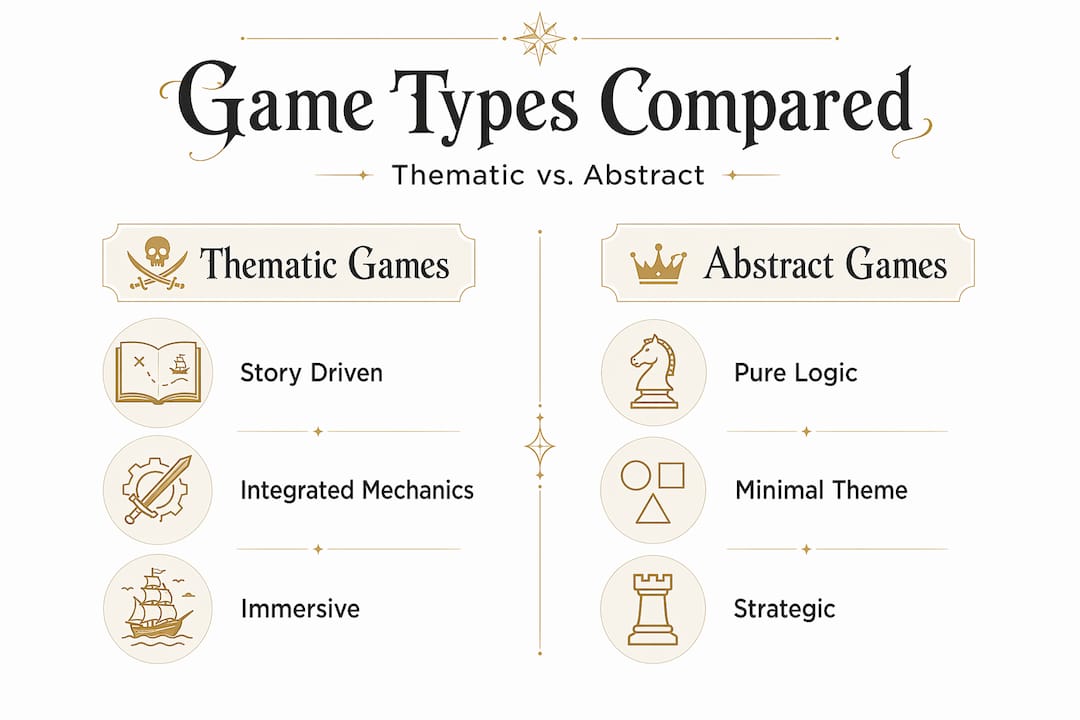
| Game Type | Theme Role | Player Focus | Example |
|---|---|---|---|
| Abstract | None or cosmetic | Pure logic and pattern | Chess, Go |
| Eurogame / Strategic | Minimal, functional | Optimization and efficiency | Agricola, Brass |
| Pasted-on Theme | Decorative only | Mechanics divorced from story | Many mass-market titles |
| Thematic | Fully integrated | Narrative, experience, immersion | Gloomhaven, Arkham Horror |
Abstract games like Chess are pure logic. The pieces have names, but a rook does not behave like a castle because of any story reason. The theme, such as it is, does not inform the rules at all.
Eurogames, often called strategic or “German-style” games, prioritize decision-making and resource optimization. They may have a theme (farming, trading, building), but that theme rarely drives the mechanics. You could rename the farms as factories and the game would feel identical.
The pasted-on theme problem is the most common failure in board game design. A game where you collect colored cubes and the rulebook calls them “ancient artifacts” is not a thematic game. The story is a label, not a design choice.
Thematic games ask a different question during design: “What would this character actually do in this situation?” That question shapes the mechanics from the ground up, which is why matching theme scale to mechanics prevents disjointed experiences and creates genuine cohesion.
How to choose a thematic game that works for you
Knowing what defines a thematic game is one thing. Finding the right one for your table is another. Here is a practical approach.
-
Start with genre resonance. Choose a theme you already find interesting. Pirate adventures, cosmic horror, ecological strategy, dungeon crawling. Your enthusiasm for the setting will carry you through a longer rulebook.
-
Check whether mechanics match the theme. Read a few reviews and ask: do players describe moments where the game felt like its theme? If reviewers talk about tension, story beats, or memorable events, the mechanics are probably doing their job.
-
Consider complexity vs. payoff. Many thematic games have longer setup and more rules than abstract or strategic games. That complexity pays off in richer experiences, but you need a group willing to invest the time. Wingspan offers accessible rules with deep strategic thematic depth, making it a great entry point.
-
Look at expansions. Strong thematic games often have expansions that deepen the world and add new story content. A base game with strong expansion support signals that the designers built something worth extending.
-
Match the social experience to your group. Some thematic games are cooperative (everyone wins or loses together). Others are competitive or include deception mechanics. Know your group’s preferences before you buy.
Pro Tip: Before committing to a long, complex thematic game, watch a playthrough video online. Seeing the game in motion reveals whether the theme actually comes alive at the table or just looks good on the box.
My take on what thematic design really demands
I’ve spent years playing and thinking about thematic board games, and the thing I keep coming back to is this: the best thematic games are not the ones with the most elaborate lore. They are the ones where you forget you are following rules.
In my experience, the games that truly deliver on their themes are the ones where a mechanic makes you gasp because of what it means in the story, not just what it does on the board. When a character you have been developing for ten sessions finally falls, and the game has a rule that makes that permanent, that is not a mechanic. That is grief.
What I have learned from playing games across every genre is that theme without mechanical support is just marketing. I have played plenty of games with stunning artwork and rich lore that felt completely hollow at the table because the rules never cared about the story. And I have played games with simple components that felt deeply immersive because every rule reflected the world they were trying to create.
The game design principle of building a primary theme, main message, and secondary themes into the design structure is not just theory. It is the difference between a game you play once and a game you talk about for years.
My honest advice: do not chase complexity. Chase integration. A thematic game that does one thing brilliantly will always beat a sprawling game that does ten things superficially.
— Nordic
Explore thematic games at Nordicpirates
If this breakdown has you ready to find a thematic game that actually delivers on its promise, Nordicpirates has something worth exploring. Lying Pirates is a standout example of theme and mechanics working in lockstep. The bluffing is the spine of the game, and every round feels like a genuine pirate standoff rather than an abstract exercise in probability.

With over 16,000 copies sold and a 7.2 rating on BoardGameGeek, Lying Pirates has earned its reputation for high-quality components and genuinely memorable moments. You can start with the base game to get the core experience, or go straight to the BIG BOX edition for the full thematic package. If you want to extend the adventure, the Cities of Greed expansion adds new layers of strategy and story. Browse the full Nordicpirates game collection and find the thematic experience your table has been missing.
FAQ
What is a thematic board game?
A thematic board game integrates narrative setting, visual design, and game mechanics so the rules reinforce the story. The theme is not decorative. It drives every decision and component in the game.
What defines a thematic game vs. a pasted-on theme game?
A thematic game has mechanics that justify the story, meaning you cannot swap the theme without changing the rules. A pasted-on theme game uses story as decoration while the mechanics operate independently of the narrative.
What are some of the best thematic board games?
Widely recognized examples include Gloomhaven, Arkham Horror: The Card Game, Spirit Island, Wingspan, and Lying Pirates. Each uses its setting to shape gameplay rather than simply decorate it.
How do I choose a thematic game that fits my group?
Start with a genre your group already enjoys, then check whether reviewers describe memorable story moments during play. Match complexity to your group’s patience, and consider whether you want cooperative or competitive play.
Why do mechanics matter so much in thematic games?
Mechanics are the mechanism through which players experience the theme. Without mechanics that reflect the story, the theme remains passive. With them, every rule becomes a story beat and every decision feels meaningful within the game world.
Share:
How to Pick a Holiday Family Board Game Everyone Loves